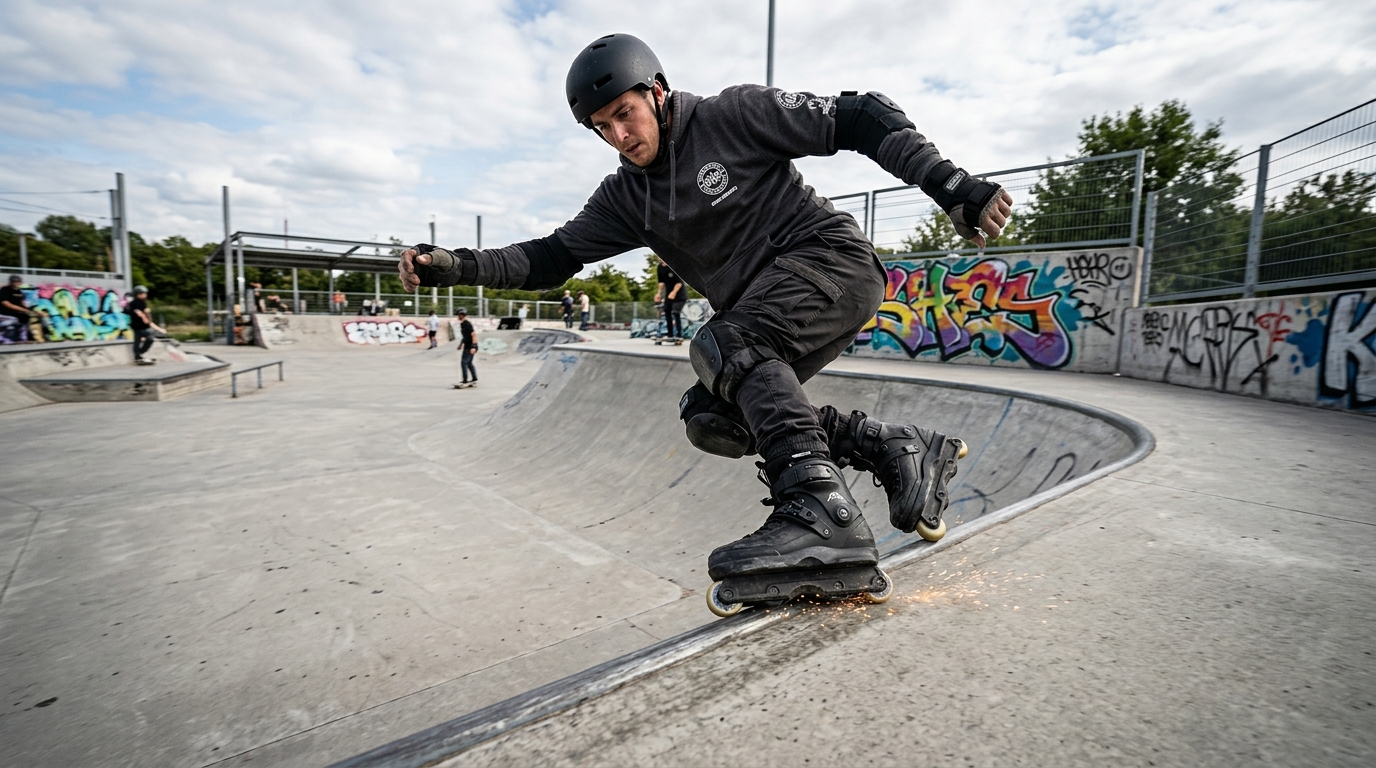
Roller Freestyle (widely known as Aggressive Inline Skating) is the adrenaline-charged action sport discipline of roller sports. Athletes utilize heavily reinforced, shock-absorbing inline skates to perform mind-boggling grinds along handrails, aerial flips off quarterpipes, and high-flying airs above 14-foot vert ramps in specialized skatepark arenas.
The Competitive Arenas of Roller Freestyle
Sanctioned under World Skate and RSFI, roller freestyle competitions are conducted across three primary formats:
Street & Park
Athletes navigate a concrete plaza course featuring stairs, handrails, ledges, banks, and funboxes, evaluated on line difficulty, grind variety, speed, and clean landings.
Bowl / Park Transition
Riders drop into curved concrete swimming pool-style bowls, maintaining high centrifugal speed to launch big transfer airs, lip trick stalls, and coping grinds.
Vert (Halfpipe)
Performed on massive 12-to-14-foot vertical halfpipes. Skaters pump the transitions to launch 6 to 12 feet above the coping, executing 540s, 720s, McTwists, and flatspin flips.
Anatomy of an Aggressive Inline Skate
- Soul Plate & Negative Plate: Broad, ultra-durable nylon/composite sliding plates mounted to the bottom of the boot, enabling skaters to slide along coping and ledges.
- H-Block & UFS Frame: A deep central groove in the frame between the middle wheels for locking onto handrails and round pipes.
- Anti-Rocker Wheel Setup: Two small, hard outer wheels (58mm–60mm) for rolling, with two tiny rock-hard center grinding wheels (42mm–47mm) to prevent wheel-bite during rail grinds.
- Shock Absorber: Thick gel or elastomer heel pads beneath the liner to absorb high-impact landings from massive drops.
Youth Skill Progression in the Skatepark
| Phase | Core Maneuvers & Benchmarks | Safety Requirement |
|---|---|---|
| 1. Skatepark Basics | Pumping transitions, carving bowls, dropping in on 3ft–5ft quarterpipes, fake (backward) riding, and 180 airs on banks. | Mandatory certified helmet, hard-cap knee pads, elbow pads, and wrist guards. |
| 2. Foundational Grinds | Frontside, Soul Grind, Mizu, and Makio locked onto low practice boxes and flat coping ledges. | Knee gaskets underneath pads to cushion repetitive knee sliding. |
| 3. Advanced Tech & Airs | Royale, Farfegnugen, Unity, Torque Soul, 360 drop-ins, and disaster grinds onto handrails. | Padded impact shorts and mouthguard for street course competition. |
| 4. National Championship | 540 spins, backflips into resi-mats/foam pits, coping stalls, full park run composition at RSFI Nationals. | National contest safety compliance and official athlete registration. |
Career & Professional Opportunities
1. Pro Rider Sponsorships & Global Contests
Roller freestyle is celebrated worldwide at extreme sports events such as FISE World Series, Winterclash, and the World Skate Games:
- Pro Skate Brands: Companies like USD, Razors, Roces, Them Skates, Kizer, and Remz sign pro and amateur riders, providing international equipment contracts, travel stipends, and signature pro-model products.
- Extreme Sports Festivals: Contests offer international cash prize purses for podium finishes in Street, Park, and Vert divisions.
2. Film, Television & Stunt Doubling
The high-impact stunts and athletic air control of aggressive skaters translate directly into professional stunt doubling for movies, action sports television, and entertainment showcases in the Indian and international media industries.
3. Skatepark Design & Action Sports Consulting
With smart cities and private resorts building concrete skateparks across India, experienced freestyle athletes work as paid skatepark designers, park safety inspectors, and municipal action sports advisors.
4. Coaching & Action Sports Clinics
Operating skatepark coaching clinics and youth drop-in camps offers lucrative entrepreneurship opportunities for accomplished freestyle riders in urban centers.
Explore all roller sports in our Complete Guide to Skating Disciplines in India.