Inline Hockey is the electric, high-scoring evolution of hockey on wheels. Played on inline skates across smooth synthetic sport court tiles or polished indoor surfaces, inline hockey combines the lightning speed of ice hockey with the continuous, flowing transition play of open-court athletics. With no offside or icing restrictions, the action never stops.
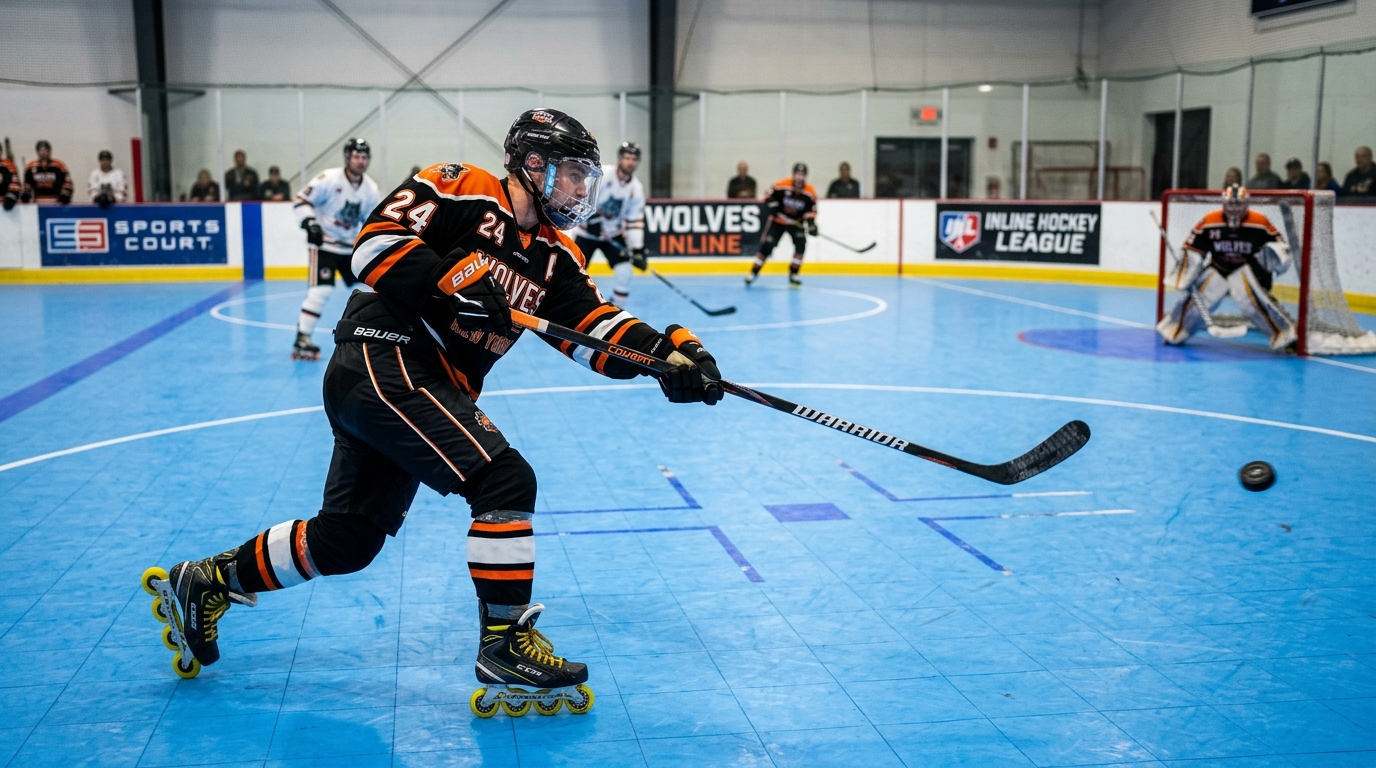
How Inline Hockey Is Played
Governed internationally by World Skate and nationally by RSFI, inline hockey features distinct technical rules that separate it from both quad roller hockey and ice hockey:
- Roster & Team Size: 4 Outfield Skaters plus 1 Goalkeeper on the floor at a time (compared to 5 skaters in ice hockey). This creates tremendous open space for breakaways, dynamic passing, and 1-on-1 dekes.
- The Puck: An engineered plastic puck (typically 100–120 grams) equipped with specially raised nylon glide pins that eliminate friction, allowing the puck to slide effortlessly across dry inline court tiles.
- Zero Offside & Zero Icing: Unlike traditional ice hockey, inline hockey features no offside lines or icing calls. Players can stretch pass the length of the rink, resulting in nonstop end-to-end rushes.
- Non-Checking Rules: Body checking is strictly prohibited. The focus is entirely on exceptional edge agility, puck protection, stick checks, and pinpoint shooting.
- Match Duration: Two halves of 20 minutes (stop clock) with rolling line changes on the fly.
Inline Hockey vs. Roller Hockey (Quad): Key Differences
| Feature | Inline Hockey | Roller Hockey (Quad) |
|---|---|---|
| Skates | Inline hockey skates (3 or 4 wheels in a line, Hi-Lo setup) | Quad roller skates (4 wheels on 2 parallel axles) |
| Projectile | Flat plastic puck with glide runner pins | Hard vulcanized cork/rubber ball |
| Stick Style | Curved composite/carbon ice hockey stick blade | Curved cane/wooden flat-bottomed rink hockey stick |
| Team Size | 4 Skaters + 1 Goalie (Total 5 on floor) | 4 Skaters + 1 Goalie (Total 5 on floor) |
| Pacing | Ultra-fast transition, wide open breakaways | Tactical set-piece passing, tight rotational cycling |
Youth Player Progression in India
Inline hockey has experienced explosive growth across school campuses, sports academies, and district associations in India:
- Grassroots Academy (Ages 6–9): Basic inline stride, crossover acceleration, hockey stops, two-handed stick positioning, and forehand/backhand puck handling.
- Sub-Junior Tournaments (Ages 10–13): Wrist shots, snapshot releases, positional coverage (diamond formation vs. box defense), and district/state championship competition.
- Junior National Championship (Ages 14–17): Power play execution, penalty kill tactics, one-timers, RSFI Junior Nationals, and SGFI School Games.
- Senior National & Team India (Ages 18+): National selection trials for the Indian Contingent to the Asian Inline Hockey Championships and World Skate Games.
Higher Education & Career Opportunities
1. Sports Quota University Admissions in India
National medalists in inline hockey benefit from reserved athletic seats in recognized Indian universities:
- Delhi University (DU) & Punjab Universities: Top-tier academic colleges offer dedicated sports quota admissions for state and national medalists.
- Engineering & Management Colleges: Leading private and state universities in Tamil Nadu, Karnataka, and Maharashtra offer athletic scholarships and fee waivers.
2. Overseas Collegiate & Club Opportunities
In the United States, Canada, and Europe, inline hockey is deeply integrated into college and tournament systems:
- NCRHA (National Collegiate Roller Hockey Association, USA): Over 150 American universities (including Arizona State, Lindenwood, Penn State) compete in collegiate inline hockey championships, offering international students campus athletic pathways.
- Pro Tournaments & Leagues: NARCH (North American Roller Hockey Championships) and State Wars host global pro divisions with substantial prize money and equipment contracts.
3. Government Employment via Sports Quota
As an officially recognized discipline under RSFI and MYAS, national medalists in inline hockey are eligible for sports quota recruitments in Indian Railways and state police departments.
4. Coaching & Rink Management
With multi-sport turf and sport-court arenas opening across Indian metropolitan areas, certified inline hockey coaches and youth clinic directors enjoy rewarding full-time and weekend coaching roles.
Essential Player Equipment
- Skates: Stiff-boot inline hockey skates with 76mm–80mm Hi-Lo wheel setups (smaller front wheels for tight turning, larger rear wheels for top speed).
- Stick: Lightweight carbon-fiber composite hockey stick.
- Protection: Helmet with full wire cage or polycarbonate visor, padded hockey gloves, elbow pads, shin guards, and inline hockey pants with built-in girdle.
- Goalie Gear: Full leg pads, catching glove (trapper), blocker, chest/arm protector, and goalie mask.
Compare all 10 roller sports in our Complete Guide to Skating Disciplines in India.